
From his seat at the Pismo Beach bar Jeremy could watch reflections in the smudged cracked mirror above the liquor bottles. He watched people standing behind him as Thorpe rose from his seat and began to sing the way he recently did more and more often.
Nobody paid Thorpe any attention.
Most days Thorpe stayed seated, reciting mysterious verses like the specter of a long-gone North Beach poet whose words now collect dust on shelves in the well-lit San Francisco bookstore across the street from the bar where the king of the beatniks used to drink.
Thorpe sang in a low growl.
“Jamie rounds the corner in his red Stingray Chevrolet, racing to another gig the guitar ghost must play. Ripping down the highway where forever music stays, Jamie rounds the corner in his red Stingray Chevrolet.”
In a voice rough as gravel road Thorpe took the octaves up and down with the ease of a stock car driver leaning into the curves of a dirt track speedway. For the next verse he switched from singing to reciting the lyrics.
“No one saw the sadness build behind that toothy smile. Ripping up the coastline singing music Jamie style,” he said. “No one saw the heartfelt pain he carried for a while, cruising by the ocean making music by the mile.”
Nobody in the bar but Jeremy seemed to be listening to Thorpe. Regulars pegged him as mildly mentally ill from acid trips blended with depression mixed with one or another personality disorder.
This was maybe the fifth time Jeremy saw Thorpe perform in the past two months. The bartender kept going about his business washing glasses, drawing draft beers, lighting cigarettes. Some people still smoked and vaped in Dank’s Tavern, defying state and local laws that banned smoking. Even nonsmokers put up with the thick gray poison that hung in the air. Customers considered themselves outlaws and worse. Hang out somewhere else if you didn’t like the vibe. Maybe that’s why Thorpe felt at ease, comfortable enough to sing whether his audience liked it or not. Now he slid back into singing the tune he wrote not long after hearing the bad news nobody else in the bar heard about the man in the song.
“Jamie rounds the corner in his red Stingray Chevrolet, racing to another gig the guitar ghost must play. Tearing down the highway where forever music stays, Jamie rounds the corner in his red Stingray Chevrolet.”
The song built like a stable ballad, a melody Jeremy imagined would sound best electric with a driving lead guitar, one righteous riff good for any Central Coastal California hard rock radio show. Sometimes at night when he tossed awake in bed he imagined Thorpe singing in a real bar band where people appreciated his work and applauded his spirit. Thorpe eased into the next verse, picking up the pace for a fast finish all the way to the end.
“In Yardley, Pee Ay, Nashville and in Cali-for-NI-A our guitar ghost sings rock and roll for yet another day. Paid his dues and now he’s free, he’ll always stay that way. Jamie rounds the corner in his red Stingray Chevrolet.”
Jeremy closed his eyes and nodded his head as Thorpe wrapped it up.
“Tearing down the highway where forever music plays. In his red Stingray Chevrolet. For yet another day. Yeah, yet another day.”
After a ten second silence Thorpe sat back down, finished his beer in two swallows and lit a smoke. Dull light shined from cheap silver rings he wore on both hands like brass knuckles on eight fingers. Somebody once said Thorpe packed a powerful punch in the ring when he fought in Los Angeles as an amateur boxer. When he stood to leave, he pulled the black cape he wore snug around his shoulders and moved silently through the crowd, disappearing out the door and into the shadows.
No obituary appeared online or in a newspaper when Thorpe died a week after his last performance. Dank’s drinkers didn’t miss him. Jeremy did. Word on the street was Thorpe shot himself in the room he rented by the week above the fish and chips shop near the pier by the beach.
Jeremy eventually heard talk that Jamie in Thorpe’s song had been a real person, a lifelong rocker who played guitar and did his best as a singer/songwriter more than good enough to deserve to do better than he did. Good enough to be better known that what he was. He wondered how Thorpe knew Jamie and why he paid obsessive tribute to a dead man through the power of a song almost nobody wanted to hear.
Jeremy found out Jamie shot and killed himself, too, sitting in his car in a Nashville parking lot.
The next time Jeremy stopped by Dank’s he took the seat at a table for two where Thorpe always sat. He lit a cigarette from the pack he bought that morning even though he normally didn’t smoke. Twisting a new silver skull ring he wore on his middle finger, he promised to buy and wear more rings. Standing slowly, the words to Thorpe’s song came easily because he had written them down over the past few months and practiced singing them at home.
Jeremy stood, singing for Thorpe and Jamie. Mostly, though, he sang for himself, for the courage he needed to help still cold desolation that puts guns in hands that kill hope, to help prevent raw passion from racing forever into the lifeless lane.
In a red Stingray Chevrolet.
The Story Behind the Story
Jamie and Thorpe are characters in my short story Red Stingray Chevrolet that is based on two real people I knew. Jamie and Thorpe didn’t know each other. Jeremy is pure fiction.
Writing short stories and novels involves time, reflection and imagination. In my mind all my fiction is real. The action explodes in my head so it must be real, right?
Sadly, we’re losing more and more book readers each day to short attention spans sacrificed to short videos more addictive than hard drugs. Even people who do read don’t spend the time they should trying to understand the writers they read. For readers to truly learn from literature high and low we must dig deeper into our own minds. We must decipher why fiction writers mine the depths of their psyches and share the shiny sometimes dark treasures they discover in the search. Readers weaken and lose whenever they relinquish the mental discipline it takes to face themselves in the dirty cracked mirrors symbolized by stories they read.
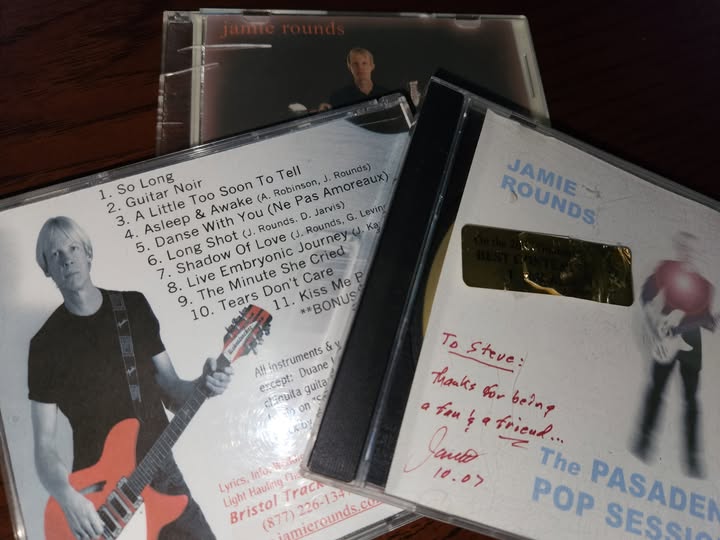
I’m not a songwriter but before I wrote Red Stingray Chevrolet I wrote the lyrics for the song Thorpe sings about my friend Jamie Rounds, who shot and killed himself in Nashville, Tennessee, on Tuesday, Jan. 22, 2013.
I last saw Jamie when he stopped for lunch sometime around 2004 at our California house when he pulled into the driveway in his red Stingray Chevrolet. We lived in Santa Maria and he lived three hours south in Pasadena near Los Angeles. On his way to Pismo Beach for work (selling some kind of insurance he was forced to sell to pay the bills) we ate strawberries as big as golf balls from nearby fields and fresh-picked avocadoes from our tree in the front yard. Jamie, Stephanie and I laughed when Jamie said I’d come a long way: living in a ranch home on a cul-de-sac in a neighborhood that reminded him of the 1960s TV show “Leave It to Beaver.”
I knew “Thorpe” when Stephanie and I lived in Harrisburg, Pennsylvania, in the early ’80s. He sat by himself at a table in the G-Man bar where Stephanie and I met and drank, sometimes talking to himself and listening to jukebox songs he played. Thorpe wore a black cape and boots, blocky silver rings and thick, straight black hair hanging below his shoulders. Rumor had it he could fight and used to. Nobody bothered Thorpe. When he got agitated and occasionally yelled out a curse, I talked quietly with him to help soothe the pain. Thorpe always left the bar alone.
Thorpe’s dead, too, of natural causes.
Some of the lyrics Thorpe sings in my story are drawn from the song I wrote about Jamie when he killed himself. I sent the lyrics to a musician friend of Jamie’s who said he’d put my words to music. He said he wanted a writer’s credit. All I wanted was a musician to sing and share a song about Jamie Rounds and the sweet gifts he offered the world through his music. The musician never got back to me about the song.
My made-up story helps Jamie and Thorpe live through their spirits, the strong influence they laid on people who knew them. If we pay attention we pick up on golden vibes from saints and sinners who appear as sparks in our lives, igniting some darkness we all navigate the best we can. Some of us deal with shadows better than others.
Rebels like Jamie and Thorpe now travel together, continuing to light the way.
In a red Stingray Chevrolet.